

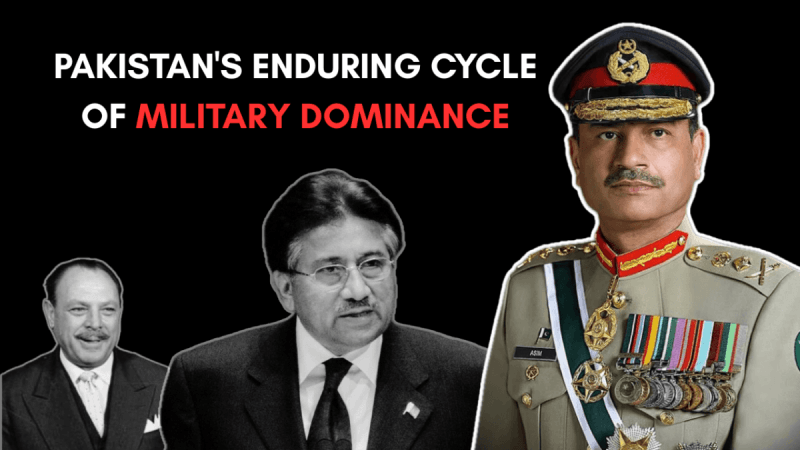
When military holds significant power over the democratic institutions, the elected governments operate under informal military oversight. In the case of Pakistan, the military has historically played a major role in shaping electoral outcomes, foreign policy, and domestic governance. Even during civilian rule, the military exerts considerable influence over key decisions. The most recent military coup which the country saw was in the year 1999 when General Pervez Musharraf ousted Prime Minister Nawaz Sharif.
The conflict began after Sharif attempted to dismiss Musharraf as the Chief of Army Staff while he was abroad. In response, Musharraf’s loyal military forces took control of key installations, including airports and television stations. Sharif’s government was swiftly overthrown, and he was arrested. Musharraf declared martial law and assumed power as the country’s chief executive. Musharraf’s regime lasted until 2008, during which he ruled as both military leader and president, heavily influencing Pakistan’s political landscape.
There have been two other major coups by the military in Pakistan. In 1958, General Ayub Khan seized power from President Iskander Mirza which marked the start of direct military rule in Pakistan. Mirza was initially facing political instability, declared martial law and dissolved the government. However, Ayub Khan, the then Commander-in-Chief of the army, swiftly removed Mirza from office, claiming the presidency. Mirza was exiled to London, and Ayub assumed full control, initiating a military regime. He later formalized his power by adopting a new constitution in 1962, establishing himself as the president. Ayub’s rule marked the beginning of Pakistan’s long history of military dominance in politics.
In 1977, General Zia-ul-Haq overthrew Prime Minister Zulfikar Ali Bhutto. Zia imposed martial law and ruled until his death in 1988. Amid growing political unrest and allegations of electoral fraud in the 1977 general elections, Zia, the Chief of Army Staff, took control of the government. Bhutto was arrested, and martial law was imposed. Zia justified the coup by citing the need to restore order and eliminate corruption. Over time, he consolidated his power, eventually becoming president in 1978. Zia ruled Pakistan until his death in a plane crash in 1988, transforming the nation into a military-dominated state.
These military regimes have frequently censored media and suppressed political opposition. Civilian governments often operate under pressure or influence from the military, affecting democratic stability. Even outside of direct rule, Pakistan’s military has played a dominant role in national politics, especially in shaping foreign policy and controlling nuclear strategy.
The courts and legal institutions have often played a controversial role in legitimizing military coups. Historically, the ‘doctrine of necessity’ has been invoked by courts to justify military takeovers. This doctrine, established by the Lahore High Court in the 1950s, was later endorsed during the 1977 coup by General Zia-ul-Haq and the 1999 coup by General Pervez Musharraf. The courts have sometimes validated these coups, arguing that military intervention was necessary to restore order and stability in times of political crisis. However, this approach has been heavily criticized for undermining Pakistan’s constitutional democracy.
