

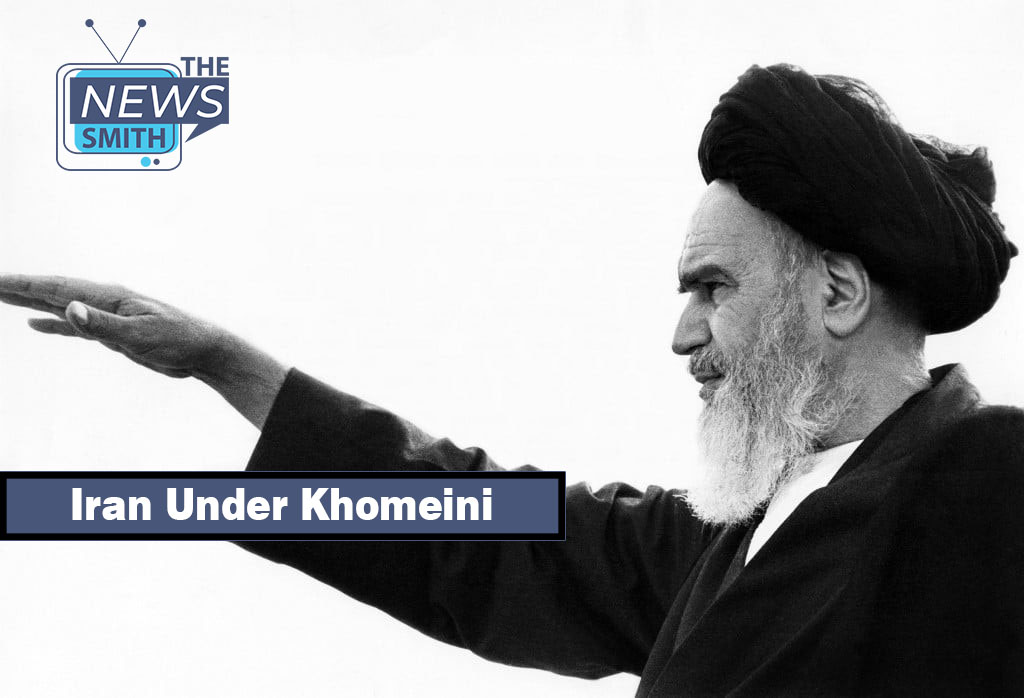
More than a million people came to welcome a 76-year-old at Mehrabad Airport and along the streets when he came back to Iran on February 1, 1979, after 15 years in exile. To his supporters, he was a religious leader and a revolutionary icon who redefined Islamic governance. A man with not many critics in Iran at the time later left a legacy of representing an authoritarian rule under the guise of religion.
The Backdrop
Ayatollah Ruhollah Khomeini was an Iranian Shiite cleric, revolutionary leader, and the founder of the Islamic Republic of Iran. Born in 1902 in Khomein, Iran, he became a prominent religious scholar and gained the title “Ayatollah,” a high rank in Shia Islam.
Iran then was ruled by second monarch of Pahalvi dynasty Mohammad Reza Pahlavi. He was known for modernization and secularization under the “White Revolution”, a series of reforms aimed at industrial growth, land reform, and women’s rights. Being a strong U.S. ally during the Cold War, he positioned Iran as a regional power. He faced widespread opposition due to autocratic rule, widespread corruption, use of SAVAK (secret police) to suppress dissent and westernization that many religious Iranians opposed.
Khomeini emerged as a vocal critic of the Shah of Iran, Mohammad Reza Pahlavi, especially condemning Western influence and the Shah’s secular modernization policies. For years, Khomeini had been the symbolic leader of the opposition to the Shah, speaking out against his authoritarian rule, Westernization policies, and disregard for Islamic values.
Khomeini was exiled in 1964 due to his outspoken criticism of the Shah’s reforms, especially the “White Revolution,” which he viewed as anti-Islamic and a threat to Iranian sovereignty. He continued to spread his ideas, particularly the concept of Velayat-e Faqih (Guardianship of the Islamic Jurist), arguing that a senior Islamic cleric should lead the government.
During his exile in Iraq and later in France, he continued to inspire opposition through speeches, writings, and recordings that were smuggled into Iran, rallying people against the regime.
By late 1978, millions of Iranians were demonstrating in the streets, and the Shah’s grip on power weakened. In January 1979, the Shah left Iran under pressure, creating a political vacuum. With the monarchy effectively collapsing and immense popular support behind him, Khomeini returned to Iran on February 1, 1979, after 15 years in exile. His return marked a turning point in Iranian history. Just days later, the monarchy was overthrown, and Khomeini emerged as the leader of the new Islamic Republic, reshaping the country’s future.
Khomeini’s Authoritarian Rule
Ayatollah Ruhollah Khomeini ruled Iran after leading the 1979 Islamic Revolution that overthrew the Shah. He became the Supreme Leader, Iran’s highest authority, combining religious and political power. This position was created in the new constitution approved by referendum in December 1979.
As Supreme Leader from 1979 until his death in 1989, Khomeini shaped Iran into an Islamic Republic based on Shia Islamic principles. He had final say over all state matters, including the military, judiciary, media, and foreign policy. Khomeini introduced a system called “Velayat-e Faqih” (Guardianship of the Islamic Jurist), placing clerics in key positions. His rule transformed Iran into a theocratic state with deep religious, social, and political changes. Khomeini had ultimate authority over government policy, military and security forces, judiciary, media, approval or dismissal of the President and oversight of laws to ensure they conformed to Islamic principles.
Under Khomeini’s leadership, Iran transitioned from a Western-aligned monarchy to an Islamic theocracy. He rejected Western political and cultural influences, promoting a vision of governance rooted in Islamic principles. This shift had profound implications for Iranian society, law, and foreign policy. Domestically, his rule saw increased enforcement of Islamic laws, restrictions on civil liberties, and significant changes in gender roles and cultural norms. Politically, Khomeini’s Iran became a staunch opponent of both the United States and Israel, coining the phrase “Death to America” that continues to resonate in certain circles.
Internationally, Khomeini inspired various Islamic movements, particularly among Shiite communities in the Middle East. His stance against secularism and imperialism appealed to many disaffected Muslims. However, his legacy is also marked by controversy—his rule included mass executions of political prisoners, suppression of dissent, and the eight-year Iran-Iraq War, which caused massive human and economic losses.
His 1979 Islamic Revolution in Iran had a profound and destabilizing impact on the Iraqi state under Saddam Hussein. Khomeini’s vision of a Shi’a Islamic theocracy alarmed the secular, Sunni-dominated Ba’athist regime in Baghdad and prompted a series of dramatic political, social, and military shifts within Iraq. One of the most widely condemned aspects of Khomeini’s rule was the 1988 mass execution of thousands of political prisoners, many of whom were leftists or affiliated with the People’s Mojahedin of Iran (MEK). Critics view this as a grave human rights violation.
Khomeini’s strict interpretation of Islamic law also drew criticism for suppressing women’s rights, restricting freedom of religion, and enforcing harsh punishments. Women were forced to wear the hijab, and legal inequalities between men and women were codified. Critics accuse him of exporting revolution and destabilizing the region, particularly through support for militant groups like Hezbollah. His rhetoric, especially against the West and Israel, contributed to Iran’s isolation and the long-standing tension with the United States.
Even after his death in 1989, Khomeini’s influence endures. Iran’s political system remains largely based on the principles he established, and his image and teachings are prominently upheld by the state. A revolutionary for some, Khomeini is considered to have transformed Iran into a theocratic Islamic Republic, where political power is closely intertwined with Shia Islamic ideology and clerical rule.
